
Topical hub
UK Electric Bike Rules: 250W, 15.5mph and EAPC Law Explained
Plain-English UK EAPC rules covering 250W motors, 15.5mph assistance, throttles, licences, insurance and road legality.
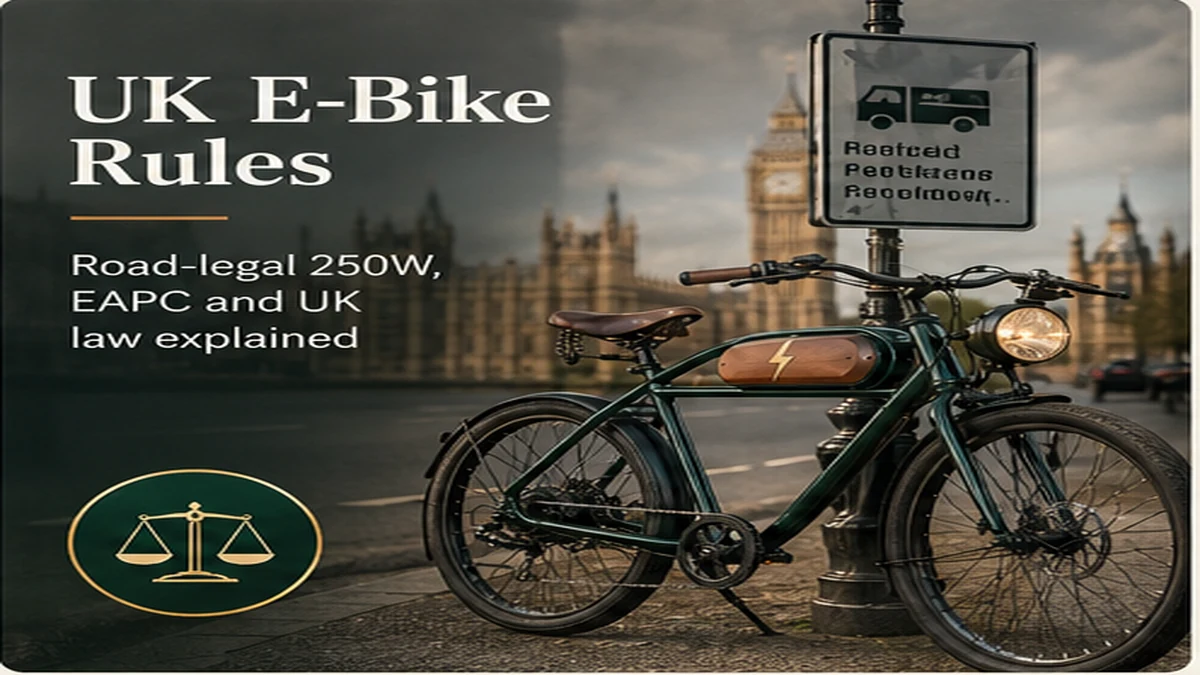
Quick facts
- EAPC stands for electrically assisted pedal cycle.
- The motor assistance limit is 15.5mph, also shown as 25km/h.
- The continuous rated motor power limit is 250W.
- The bike must have pedals capable of propelling it.
- Non-compliant bikes may be treated as mopeds or motorcycles on public roads.
Guides in this hub
What is an EAPC in UK law?
An EAPC is a pedal cycle with electric assistance that meets specific limits. For most readers, the key points are simple: the bike needs working pedals, the motor must not be rated above 250W continuous power, and the motor must stop helping once the bike reaches 15.5mph.
The rules matter because a compliant EAPC is treated like a pedal cycle for many everyday purposes. It can usually be used on roads and cycle lanes where ordinary bicycles are allowed, subject to normal cycling rules and local restrictions.
Understanding EAPC classification is especially important for retro and vintage-style electric bikes because their moped-inspired designs can attract police attention. A bike that looks like a motorcycle but qualifies as an EAPC has exactly the same legal standing as a conventional electric bicycle.
- The motor must be rated at or below 250W continuous power.
- Electrical assistance must cut off at 15.5mph (25km/h).
- The bike must have working pedals that can propel it.
- The rider must be at least 14 years old.
- No driving licence, registration, insurance or vehicle tax is needed.
Do you need a licence, insurance or tax?
For a compliant EAPC, GOV.UK guidance says you do not need a driving licence, vehicle tax, registration or insurance. That is one reason 250W road-legal e-bikes are attractive for commuting, local shopping and gentle leisure riding.
Insurance can still be sensible for theft, damage and liability, but it is not the same as a legal requirement for a compliant EAPC. If a bike falls outside EAPC limits, the position can change sharply.
Many UK riders choose voluntary e-bike insurance anyway, especially for higher-value retro models. Dedicated cycle insurance policies can cover theft, accidental damage, public liability and even legal costs — typically for £50 to £150 per year depending on the bike's value and where you live.
When might an electric bike stop being road legal?
A bike may fall outside EAPC treatment if it has a motor rated above 250W, if electrical assistance continues above 15.5mph, if it lacks pedals that can propel it, or if a throttle works in a way that does not fit the permitted rules.
Some imported, moped-style or fat-tyre bikes are visually close to bicycles but technically closer to motor vehicles. Always check the manufacturer's rated power, assistance limit, throttle setup and compliance markings before buying.
The consequences of riding a non-compliant e-bike on public roads can include points on your licence, fines, vehicle seizure and insurance complications. This is particularly relevant for the growing number of powerful moped-style e-bikes sold through online marketplaces with vague compliance claims.
Where can you ride a legal e-bike in the UK?
A compliant EAPC can generally be ridden wherever a conventional bicycle is allowed — public roads, most cycle lanes, shared-use paths and bridleways. However, some local authorities restrict cycling on certain pavements, pedestrianised zones and footpaths.
National Trust land, canal towpaths and forestry trails may have their own cycling rules. Always check local signage and restrictions, particularly on narrow shared paths where pedestrian priority applies.
Common mistakes when reading e-bike listings
The biggest mistake is treating peak power as the same thing as continuous rated power. Listings may mention higher peak figures for marketing, while the legal question is whether the continuous rated output complies.
Another mistake is assuming that a bike is road legal because it has pedals. Pedals are necessary, but not enough on their own. Assistance speed, motor rating and throttle behaviour all matter.
How to verify the rules before buying
Use official guidance first, then compare it with the specification plate, manual and retailer listing. Ask the seller direct questions if a detail is unclear, and keep written answers for your records.
If a product page says private land only, off-road only or unrestricted, treat that as a warning that the bike may not be suitable for public roads without motor vehicle compliance.
Related guides
 Are Retro Electric Bikes Legal in the UK?Learn when a retro electric bike is road legal in the UK, including EAPC pedals, 250W motors, 15.5mph assistance and throttle checks.What Is a Road-Legal Electric Bike UK?A plain-English explanation of road-legal electric bikes in the UK, including EAPC rules, pedals, motor limits and speed cut-offs.250W Electric Bike Law UKThe UK 250W electric bike law explained in plain English, including continuous rated motor power, EAPC rules and buyer checks.Throttle Electric Bike UK LawPlain-English UK throttle e-bike law covering EAPCs, start assistance, older bikes, imports and what buyers should verify.
FAQs
What are the four essential requirements for a road-legal e-bike (EAPC) in Great Britain?
To be a road-legal EAPC in Great Britain, the bicycle must have working pedals, a maximum continuous rated motor power of 250W, an electrical assistance cut-off at 15.5mph (25km/h), and be ridden by someone at least 14 years old.
Can I ride an EAPC on UK pavements or pedestrian areas?
No. Electric bikes follow the same rules as conventional pedal cycles under the Highways Act 1835 and Highway Code Rule 64: cycling on pavements is prohibited unless explicitly marked as a shared-use cycleway.
What is the penalty for riding an illegal or de-restricted e-bike on UK roads?
An e-bike exceeding 250W or assisting above 15.5mph without registration is classified as an uninsured motor vehicle. Riders face a £300 fixed penalty notice, up to 6 driving licence penalty points, and police confiscation under Section 165A of the Road Traffic Act 1988.
Do e-bike laws differ in Northern Ireland?
Northern Ireland harmonised its rules with Great Britain in 2020 through the Electrically Assisted Pedal Cycles (Construction and Use) Regulations (Northern Ireland) 2020. Compliant 250W EAPCs no longer require registration, tax, or a licence in Northern Ireland.
Can a road-legal e-bike have a throttle in the UK?
A full twist-and-go throttle that propels the bike to 15.5mph without pedalling is only legal on bikes manufactured before 1 January 2016. On bikes manufactured after that date, throttles are only legal if restricted to walk-assist mode (up to 3.7mph / 6km/h) unless the machine has full L1e moped type approval.